

Cover photo: Anuv Jain live, The New Indian Express.
Anuv Jain’s songs arrive with very little of the machinery people associate with stadium-scale emotion. A voice, an acoustic guitar, a lyric that leaves more unsaid than explained. Yet that intimacy has become the basis for a serious live-music business: packed rooms, long sing-alongs, national tours and now a world-tour format.
The useful lesson is not “write sad songs and post them online.” Jain’s rise is a case study in conversion. He turned private-feeling writing into repeat listening, repeat listening into shared language, and shared language into a room full of people who already know the words. The scale came after the emotional proposition was clear.
The phrase bedroom songs is shorthand here for the close, unvarnished feeling of his early work—not a claim that every release was literally recorded in a bedroom. The documented starting point is more concrete: “Baarishein,” written, sung and composed by Jain, was uploaded to his YouTube channel as his first studio-recorded single in July 2016. YouTube
Key takeaways
- Jain built around simple, personal storytelling before expanding the spectacle; his songs make listeners feel invited into an unfinished emotional thought.
- “Husn,” independently released in 2023, reached No. 1 on Spotify and Apple Music in India with only a small social campaign, according to Jain’s 2024 interview with Rolling Stone India. Rolling Stone India
- His 2023 Guldasta tour was structured as a 10-city India run; in 2026, Dastakhat expanded that relationship into a multi-city world-tour plan. Moneycontrol, The New Indian Express
Your songs, collaborators and live history should tell one coherent story to the people discovering you next. kredl →
The first advantage was not production scale. It was emotional precision.
Jain’s early appeal was never based on trying to out-produce film music or compete with a dance record’s immediate impact. Songs such as “Baarishein,” “Alag Aasmaan” and “Gul” leave room around the vocal, which makes the listener feel close to the narrator rather than impressed from a distance. That is a specific writing choice, and it carries cleanly from headphones to a concert hall.
In a 2023 interview, Jain described himself as a storyteller whose songs have a beginning and an end. He also said many of his songs avoid repeating lyrics in a conventional pop structure. Indulge That is a useful distinction. His records do not only offer a hook to remember; they give listeners enough narrative space to attach a memory of their own.

Photo: Rolling Stone India.
What emerging writers can take from this
Write toward a feeling you can explain in one sentence, but do not over-explain it in the lyric. A listener needs a clear emotional door and enough empty space to walk through with their own story. That is more durable than trying to manufacture relatability with generic heartbreak vocabulary.
He made self-released music feel like a major cultural moment
Independent does not mean invisible. In his Rolling Stone India interview, Jain said “Husn” reached No. 1 in India on Spotify and Apple Music, and held the top spot in Pakistan for a significant period. He described the release as independent, with no substantial marketing budget beyond a few reels. Rolling Stone India
The important word is not viral. It is prepared. A song that feels personal still needs a clear title, coherent artwork, an artist profile that gives new listeners context, clips that communicate the mood, and a release rhythm that leaves room for the audience to carry it. Jain’s low-key visual and lyrical language made his social posts feel like extensions of the songs, not separate advertising.
Spotify’s 2026 India report confirms the broader environment that made this possible: I-Pop—artist-led music outside film soundtracks—made up half of Spotify’s 2025 year-end top 10 in India, with Anuv Jain among the artists charting alongside film releases. Spotify
The live phenomenon began with an audience that had already rehearsed
The reason an intimate song can fill a large room is simple: the audience arrives knowing its part. Jain’s work made that participation natural. A lyric that feels like a diary entry on headphones can become a collective confession when thousands sing it at once.
That changes how a live show should be designed. You do not need to bury the song beneath production in order to make it “big.” You need to protect the lines that brought people into the room, then create moments where the audience has permission to carry them.
In 2026, Jain described the experience of an audience singing louder than him as the live moment that stays with him. Urban Asian The comment captures the exchange at the centre of his shows: the fan is not only consuming a finished product; they are helping complete it.
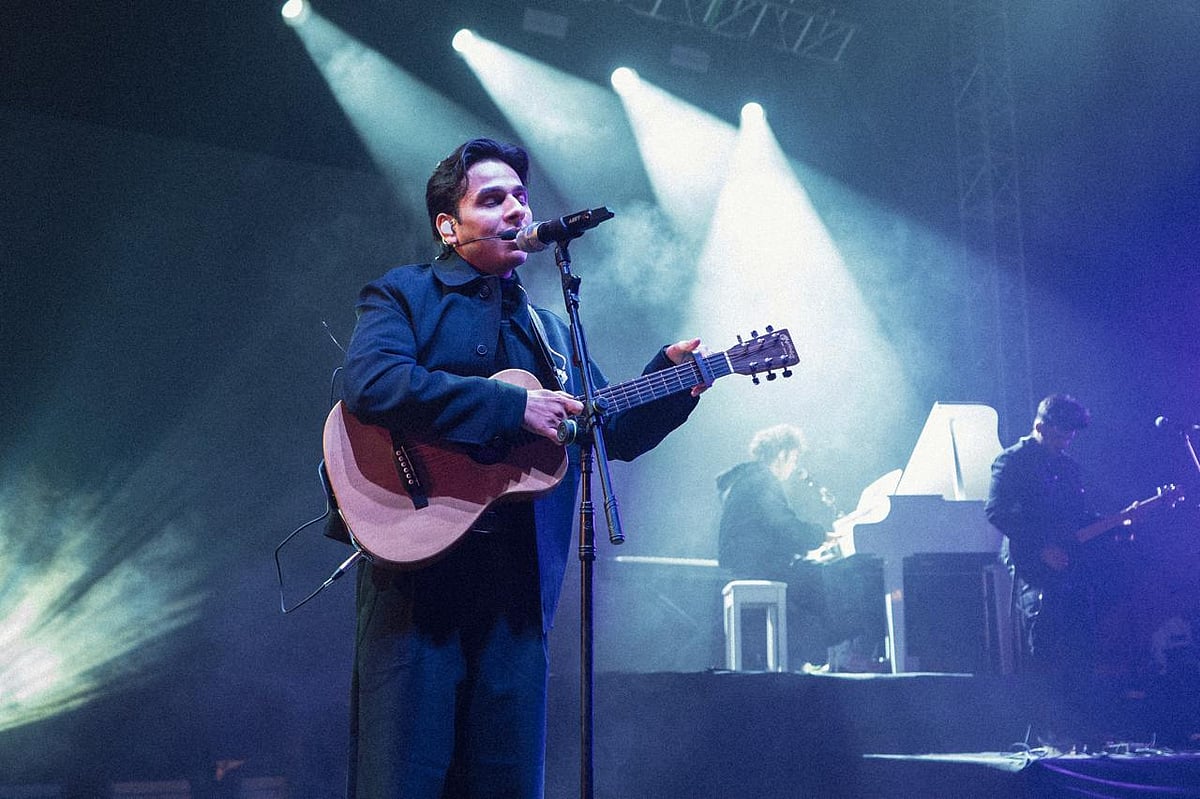
Photo: The New Indian Express.
Tours were treated as chapters, not a list of dates
Jain’s touring has a clear progression. Dastakein established the first national-tour relationship; Guldasta followed in 2023 as a deliberately bigger 10-city run through Delhi, Jaipur, Guwahati, Kolkata, Pune, Ludhiana, Mumbai and more. Moneycontrol The name itself worked as a small piece of narrative: Gul plus das (ten), a bouquet of cities and songs.
That kind of framing is more powerful than a generic “India Tour 2023” banner. It tells fans what chapter they are entering and gives each show an identity beyond its venue. For an independent artist, a tour name can tie together visual language, stage design, merchandise, setlist order, fan captions and the aftermovie.
By January 2026, Dastakhat had expanded into a world-tour plan with an India leg before dates across Australia, North America, the UK and Europe, and the Middle East. The New Indian Express That scale did not arrive as a random international leap. It followed years of fan context, online discovery and a track record of making each show feel emotionally specific.
A live show becomes a career asset when the people, places and credits behind it are documented—not lost after the last encore. kredl →
He widened the live sound without breaking the promise
The early image of Anuv Jain is one person with a guitar. A phenomenon cannot stay static, though. A larger tour requires a fuller sonic and visual vocabulary, while the core listener still needs to recognise why they came.
The recent Dastakhat imagery shows this evolution: Jain remains at the centre with a guitar and voice, but the stage can accommodate a pianist, bassist, lighting and a broader arrangement. The expansion supports the emotion instead of replacing it. The New Indian Express
This is an important live-design principle for independent artists. Scale the feeling, not merely the budget. Keep one or two signature moments nearly unchanged from the recorded version. Then use band dynamics, a call-and-response, a visual transition or a storytelling pause to make the room feel larger than the track.
The real business is attention that returns
Anuv Jain’s career is sometimes reduced to a numbers story: streaming totals, ticket demand, viral reels. Those outcomes matter, but they are trailing indicators of a more useful system. His music gives listeners a repeatable emotional experience. Social posts keep the relationship warm. Tours give the relationship a physical place to exist. Each new song adds to the catalogue that makes the next ticket easier to sell.
That is a healthier model than trying to make every release a reinvention. A new listener can begin with “Husn,” then find “Baarishein,” “Gul” or “Alag Aasmaan” and understand the same emotional world. A long catalogue with a coherent point of view turns first discovery into long-term fandom.
Build a live conversion path: One clip should lead to a full song. The song should lead to a playlist or artist page. The artist page should make the next show easy to find. The show should give the fan a memory worth sharing.
Every step needs a clear link, a clear credit trail and a reason to continue.
A practical playbook for singer-songwriters who want to play bigger rooms
Jain’s exact sound is not transferable. His career structure is.
- Write from a real detail. Start with the scene, image or unresolved thought only you can tell. Do not force a universal chorus before the verse has a point of view.
- Release a complete world. Artwork, snippets, caption language and live visuals should feel like they came from the same song.
- Leave audience space in the arrangement. A simple instrumental break, a repeated line or a held pause can become the place a crowd sings back.
- Build the first tour around genuine demand. Use listening-city data, mailing-list signups, ticket interest and community partners to choose rooms you can fill with the right audience.
- Name the chapter. Give the tour or show format an idea fans can understand and share; do not make the dates the entire story.
- Document the performance. Capture the crowd singing, the band, the venue and every collaborator. These are assets for the next city, not only recap content.
- Keep credits and agreements organised. Touring musicians, visual artists, photographers, producers and promoters all strengthen the show; name their work accurately.
How to release a song in India in 2026
Music PR in India: how to get covered by blogs, playlists and culture publications
The independent music career guide for Indian artists
Frequently asked questions
Did Anuv Jain become popular without a major-label campaign?
His early songs built through direct digital discovery, while “Husn” was independently released. In 2024, Jain told Rolling Stone India that it reached No. 1 in India on Spotify and Apple Music without a substantial marketing budget beyond a few reels. Independent does not mean unplanned—it means the artist must make the release story and audience journey work.
Why do Anuv Jain concerts feel so communal?
His songs give listeners emotionally specific lyrics and uncluttered arrangements, so people can learn and claim the lines before a concert. The live show then protects those moments instead of overpowering them. A crowd singing back is the result of years of repeat listening, not a stage trick.
What can emerging singer-songwriters learn from Anuv Jain’s tours?
Treat a tour as a named creative chapter rather than a collection of dates. Build around cities with real audience signals, keep the recorded song’s emotional core intact onstage, and document the performers and fan response. The next tour should feel like a natural continuation, not a fresh start.
Does an artist need a viral song before touring?
No. You need an audience with enough commitment to buy a ticket and bring someone along. A smaller sold-out room, a focused listening event or a repeat local showcase is a better foundation than a large reach number with no evidence of live demand.
From a private feeling to a public ritual
Anuv Jain did not turn bedroom-scale emotion into a live-music phenomenon by making it louder for the sake of it. He built songs listeners could inhabit, then designed tours where those listeners could inhabit them together.
That is the core lesson for independent artists: keep the work intimate enough to matter to one person, and organise the career well enough that thousands of people can meet inside it.
Build a public record of the songs, people and live moments that make your independent career credible. kredl →
Sources and image credits
- Anuv Jain: “Baarishein” official YouTube upload
- Rolling Stone India: Anuv Jain, Future of Music 2024
- Moneycontrol: Anuv Jain on the 2023 Guldasta India Tour
- The New Indian Express: Anuv Jain ahead of the Dastakhat World Tour
- Spotify: Indian artists finding success across languages, genres and borders