
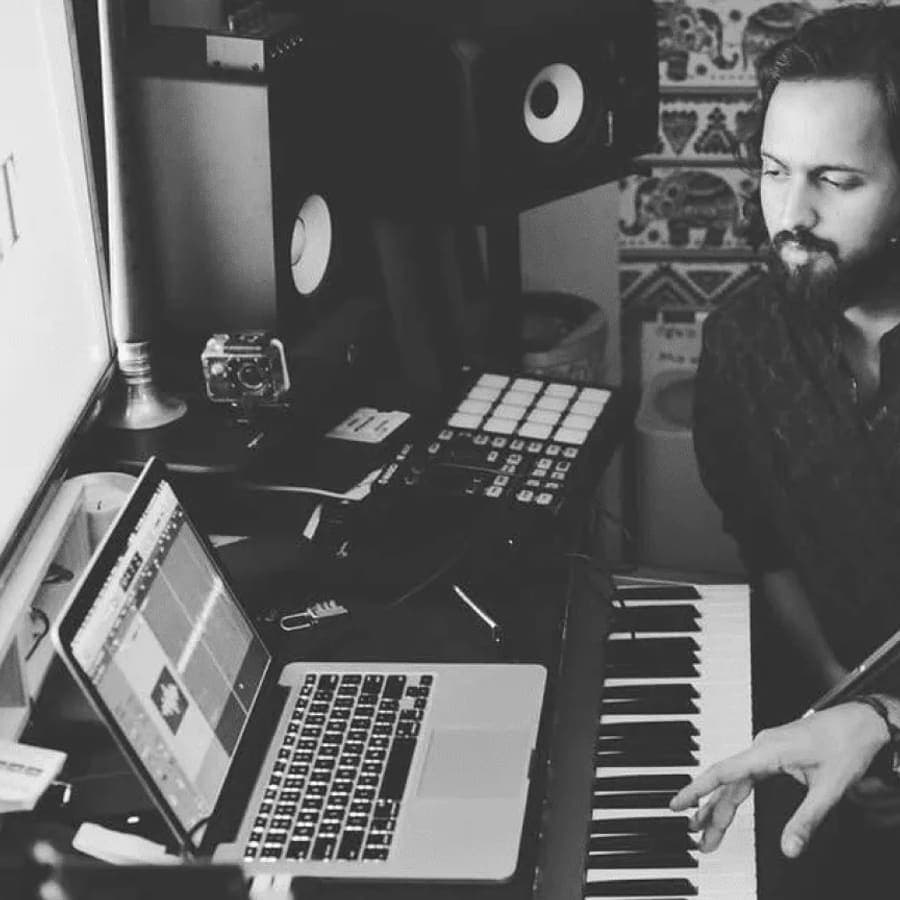
Photo: The Indian Music Diaries
Siddharth Pandit spent three years at KM Music Conservatory in Chennai — A.R. Rahman's own institution, one of the most credible music schools in India — and left before finishing. Not because it wasn't good. Because it wasn't enough. "I was learning about music, but I wasn't making enough of my own," he's said. "I wanted to get my hands dirty with real projects, collaborate, fail, learn on the job."
That decision set the pattern for everything after: formal training taken seriously, then abandoned the moment it stopped producing real work. Five years of anonymous session keyboard work in Mumbai followed. Then, slowly, an independent album series called Azaad Sangeet, a composer credit on Bandish Bandits Season 2, and by 2025, a place on Rolling Stone India's Future 25.
This is how a pianist who calls himself a bridge between Indian and Western music built a career by refusing to pick a side.
Key takeaways
- Siddharth Pandit began playing keyboard at age 5 and studied Western classical piano under Dr. Adam Greig at KM Music Conservatory, Chennai — A.R. Rahman's institution — before leaving after three years
- He spent roughly five years as a session keyboardist and jingle composer in Mumbai before building his own artistic identity
- His independent album series, "Azaad Sangeet," launched in 2019 and reached its third season (12 tracks) in September 2024, blending Indian traditional and Western classical idioms
- He composed "Hichki 2.0" for Amazon Prime's Bandish Bandits Season 2 (2024), reworking two Azaad Sangeet tracks into the show
- In 2026, he co-composed the score (with Anurag Saikia) for Netflix's Kargil War limited series "Operation Safed Sagar" — his most prominent screen-composing credit since his 2025 Future 25 recognition
Discover composers and musicians building independent careers in India. kredl →
The Starting Point: A Casio Keyboard and a Conservatory Exit
Siddharth Pandit was given a Casio SA-5 keyboard by his maternal uncle at age 5, and started playing almost immediately. He grew up across different parts of Uttar Pradesh but considers Jaipur his hometown. What drew him to the instrument in childhood is, by his own account, exactly what's kept him there: "It's this complete instrument that lets you play harmony, melody, rhythm — all at once."
He enrolled at KM Music Conservatory in Chennai — founded by A.R. Rahman — and studied Western classical piano there under Dr. Adam Greig for three years before leaving without finishing the program. It wasn't a rejection of formal training; it was a judgment that he'd absorbed what the classroom could give him and needed real projects to keep developing. That judgment led to roughly five years working as a session keyboardist and jingle composer around Mumbai's Bollywood and jazz circuit — steady, largely anonymous work that built the technical and professional foundation for what came later.
Building "Azaad Sangeet": An Independent Sound of His Own
In 2019, Pandit launched Azaad Sangeet — an independent album series he describes as "Organic Homemade Indian Independent Music," built specifically to blend Indian traditional idioms with Western classical structure. It's the clearest expression of the identity he'd later describe to Rolling Stone India: "That bridge [of Indian and Western music] is where I live, honestly."

Photo: Spotify
The project's third season, released in September 2024, ran 12 tracks across roughly 43 minutes. One standout, "Beete Nahi," features vocalist Hansika Pareek with lyrics by Alok Ranjan Srivastava — a school friend since ninth grade who left a corporate job specifically to write music with Pandit. "Alok has a composer in him, just as I have a poet in me," Pandit has said of the partnership, "and this balance helps us consistently find what works best for a song."
Facing Down Industry Skepticism
Independent, genre-blending music isn't an easy sell in an industry built around commercial formulas, and Pandit has been candid about the resistance he faced. He's recalled being told directly: "Why are you making independent music? There's nothing in this. Do commercial work." His response, in his own words: "I had a belief that this is something that I'm making and it was true to me."
Siddharth Pandit, on why he left the conservatory early: "I was learning about music, but I wasn't making enough of my own. I wanted to get my hands dirty with real projects, collaborate, fail, learn on the job." (Rolling Stone India, 2025)
Find collaborators who believe in the work before the market does. kredl →
From Uri to Bandish Bandits: Building Screen Credits
Pandit's screen work includes a production/music-team credit on "Uri: The Surgical Strike" (2019) — not the film's principal score, which belongs to composer Shashwat Sachdev, but part of its broader music team — and a co-composing credit alongside Sameer Rahat on "Faraaz" (2022). His most significant screen credit to date is Bandish Bandits Season 2 (Amazon Prime, 2024), where he composed "Hichki 2.0," a Rajasthani-inflected arrangement, with two of his own Azaad Sangeet Season 3 tracks reworked directly into the show. "It's truly a dream come true to see my independent music featured in mainstream cinema," he's said of that crossover.
The Complete Guide to Building an Independent Music Career in India
A Turning Point at NCPA
In February 2025, Pandit staged an original ensemble concert at the National Centre for the Performing Arts (NCPA) in Mumbai, with a live vocalist and instrumentalist lineup performing his compositions. He's described it as a personal turning point for his live-performance ambitions — a natural extension of a philosophy he's stated plainly: "Live music is still the most honest litmus test for a composer."
2026: Scoring Netflix's "Operation Safed Sagar"
Since his 2025 Future 25 recognition, Pandit's most prominent credit has been co-composing (alongside Anurag Saikia) the score for "Operation Safed Sagar," Netflix's six-episode limited series about the Kargil War, which premiered in August 2026. The score leans martial and orchestral rather than toward conventional Bollywood songcraft — a genuinely different register from Azaad Sangeet's Indian-Western fusion, and evidence that Pandit's range extends well beyond the sound he's best known for.
What Other Independent Musicians Can Take From Siddharth Pandit's Approach
Formal training is a floor, not a ceiling. Leaving a prestigious conservatory before finishing isn't advice to follow blindly, but Pandit's reasoning — that real projects teach what a classroom can't — is a useful filter for any artist wondering when formal education has done its job.
Independent work can double as a credibility-building portfolio. Azaad Sangeet wasn't created with a mainstream television placement in mind, but it's exactly what got two of its tracks reworked into Bandish Bandits Season 2. Work made on your own terms can still become the work that gets you hired.
A creative partnership built on genuine complementary skills compounds over time. Pandit's decade-plus collaboration with lyricist Alok Ranjan Srivastava — a friendship that predates either of their careers — shows how a long-term creative pairing can outperform a series of one-off collaborators.
Range across formats protects a career from any single genre's ceiling. Between an Indian-Western fusion album series, a Rajasthani folk-pop TV placement, and a martial orchestral war-series score, Pandit has demonstrated a range that keeps him working across very different kinds of screen and stage projects.
Build a profile that shows the full range of your work. kredl →
Meet India's Next Generation of Music Talent: 25 Artists to Watch in 2026
Frequently Asked Questions
Who is Siddharth Pandit?
Siddharth Pandit is an Indian composer and pianist who blends Indian classical traditions with Western classical structure. He studied at KM Music Conservatory in Chennai before working for years as a session keyboardist in Mumbai, and later built an independent album series, Azaad Sangeet, alongside screen composing credits including Bandish Bandits Season 2 and Netflix's Operation Safed Sagar. He was named to Rolling Stone India's Future 25 in 2025.
What is Azaad Sangeet?
Azaad Sangeet is Siddharth Pandit's independent album series, launched in 2019 and described by him as "Organic Homemade Indian Independent Music." It blends Indian traditional idioms with Western classical composition, and its third season (12 tracks) released in September 2024. Two of its tracks were later reworked for Bandish Bandits Season 2.
Did Siddharth Pandit compose the music for "Uri: The Surgical Strike"?
He's credited as part of the music production team on "Uri: The Surgical Strike" (2019), but the film's principal score was composed by Shashwat Sachdev. Pandit's role is best described as music supervision and production support rather than lead composer.
What has Siddharth Pandit worked on recently?
His most recent major screen credit is co-composing the score for Netflix's "Operation Safed Sagar," a six-episode Kargil War limited series that premiered in August 2026, working alongside composer Anurag Saikia. He also staged an original ensemble concert at NCPA, Mumbai, in February 2025.
Where did Siddharth Pandit train as a musician?
He studied Western classical piano under Dr. Adam Greig at KM Music Conservatory in Chennai, an institution founded by A.R. Rahman, before leaving the program after three years to pursue hands-on production work.
Siddharth Pandit's career doesn't read as a straight line from training to success — it reads as a series of deliberate exits from things that had stopped teaching him anything, followed by patient work on something that eventually did. A conservatory he left, five years of anonymous session work, and an independent album series built with no guarantee of mainstream attention all turned out to be exactly what got him there.
Find your next collaborator, manager, or creative partner in India's music industry. kredl →